Residency Period: 23/3/26 - 21/4/26
Joe Walker and Pat Walker are twin brothers from Ireland who began collaborating as Walker and Walker in 1989. They co-represented Ireland at the 51st International Venice Biennale in 2005 and have exhibited widely nationally and internationally.
A major mid career solo show 'Nowhere without no(w)' was held at the Irish Museum of Modern Art in Dublin (2019). Other selected exhibitions include Coalescence, at Shimmer, Shimmer, in Rotterdam, The Netherlands (2024-25); ’Threshold’ at Madonna Del Pozzo (2021) as part of The Festival dei Due Mondi, an international arts festival held yearly in Spoleto, Italy; ‘Wider than the sky’, at Artspace Boan1942, in Seoul, South Korea (2017); 'Return Inverse’ at Magazin4, Bregenzer Kunstverein, in Austria (2015); ‘Punctum’, Salzburger Kunstverein, in Salzburg, Austria (2014); ‘In the Air’ at Leitrim Sculpture Centre in Manorhamilton, Leitrim in 2013; The Owl of Minerva’ in Dublin City Gallery, The Hugh Lane Dublin (2012); ’Ill heard, ill seen’, at Sheppard Fine Arts Gallery, Reno, USA curated by Marji Vecchio (2008) and Northern Lights, Galleria Civica di Modena, Italy (2007).
Their film ‘Mount Analogue Revisited’ was selected in ‘Senses of Cinema’ by Fergus Daly as one of the best films in 2010 and was shown internationally. They curated a selection of films from Ireland for ‘Super 8’, (2011-13) which were shown at the Museum of Modern Art, Rio de Janeiro; Yerba Buena Center for the Arts, San Francisco; Künstlerhaus Berlin, and the Christopher Grimes Gallery, in Los Angeles.
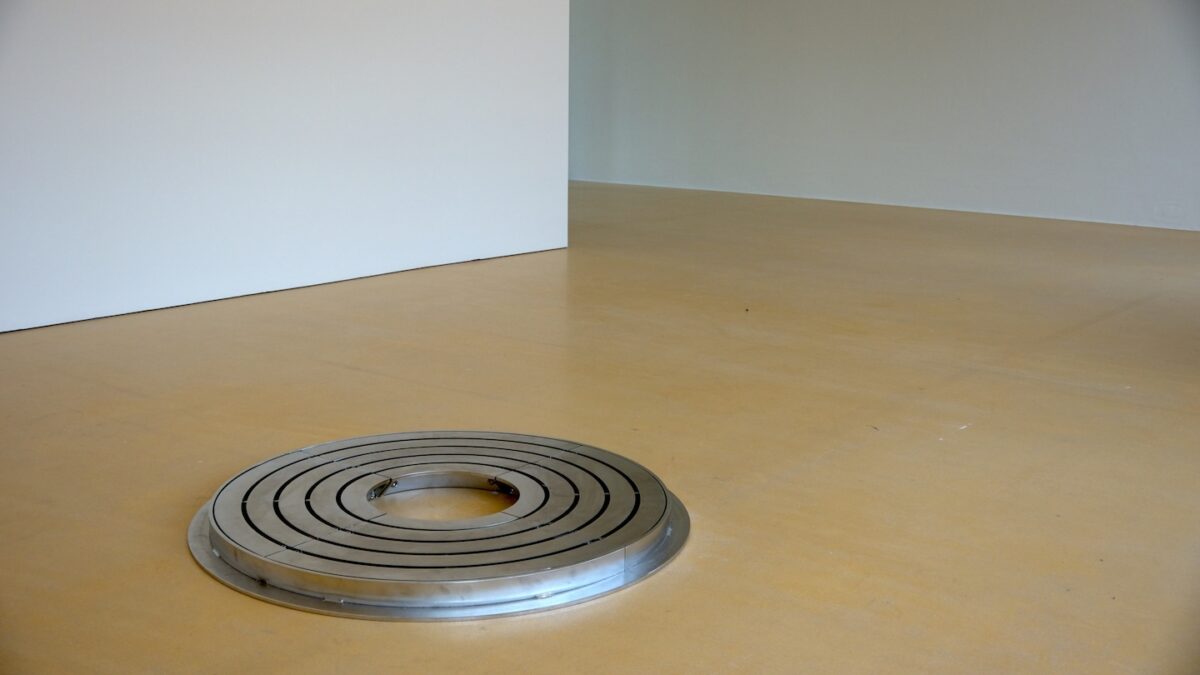
Stainless steel, 96cm diameter x 5 cm
Accompanying these works, a stainless-steel circular sculpture adhering to the language of minimalism is placed on the floor. Almost an ubiquitous object, it is a tree holder or a protective guards usually seen on some city streets. Picking up on the motif of zero which addresses the notion of absence, loss, or the void, this object is in essence is designed in time to be obsolete; as the tree outgrows its designated circle, each defined space is removed in turn. This work identifies another ongoing theme within Walker and Walker’s work; the tension between presence and absence. ‘In waiting (Oak tree)’ is an object filled with the potentiality of the physicality of a tree but is also filled with a certain redundancy, as it sits seemingly in a state of exile.
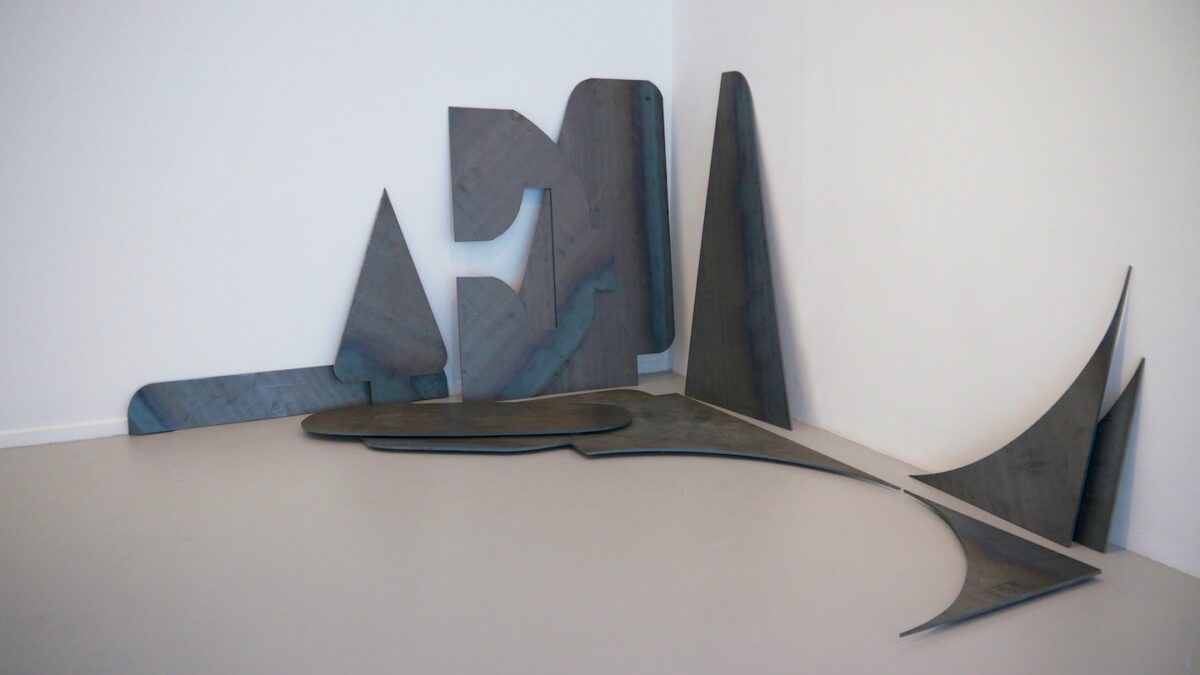
The Remnants of Love (after Robert Indiana) consists of metal offcuts of the negative spaces which surround the individual letters of Robert Indiana’s iconic LOVE sculpture. Consisting of large slabs of steel stacked on top of each other, leaning against the wall, it is a memorial of sorts yet it speaks of the incommensurability of memory. Chaotic in its appearance, making concrete the necessary support to articulate the word which would have been previously discarded or unappreciated, left as a residue in a workshop, it possesses an ambiguous materiality between melancholia and affirmation.
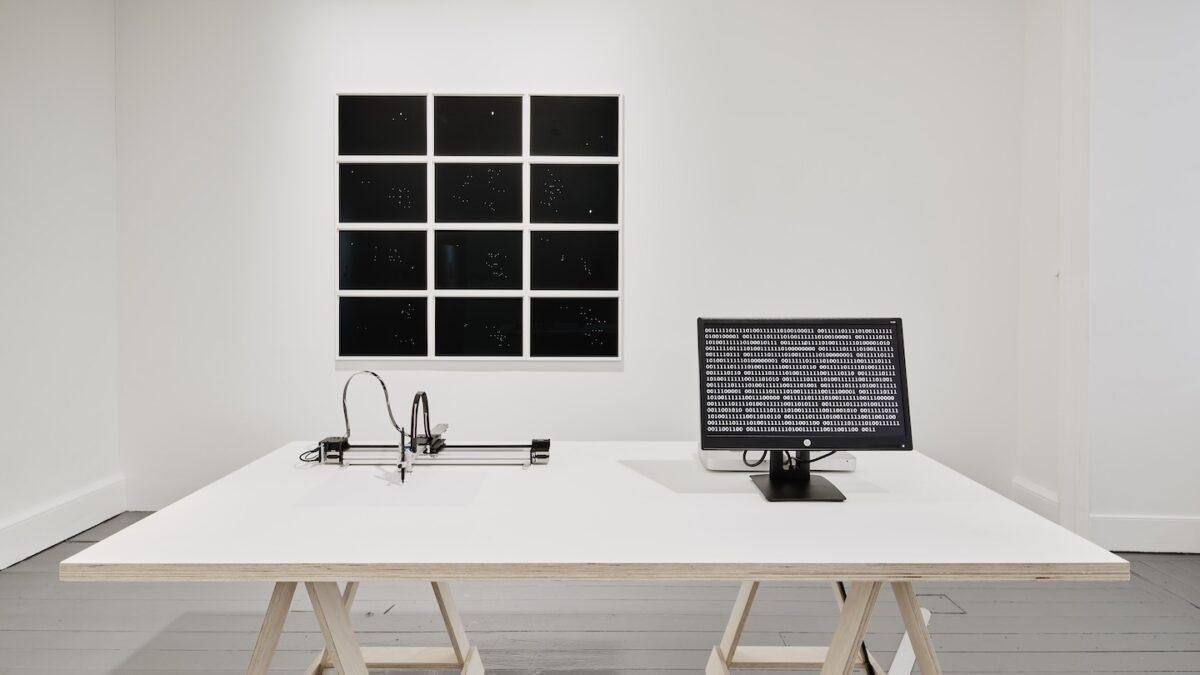
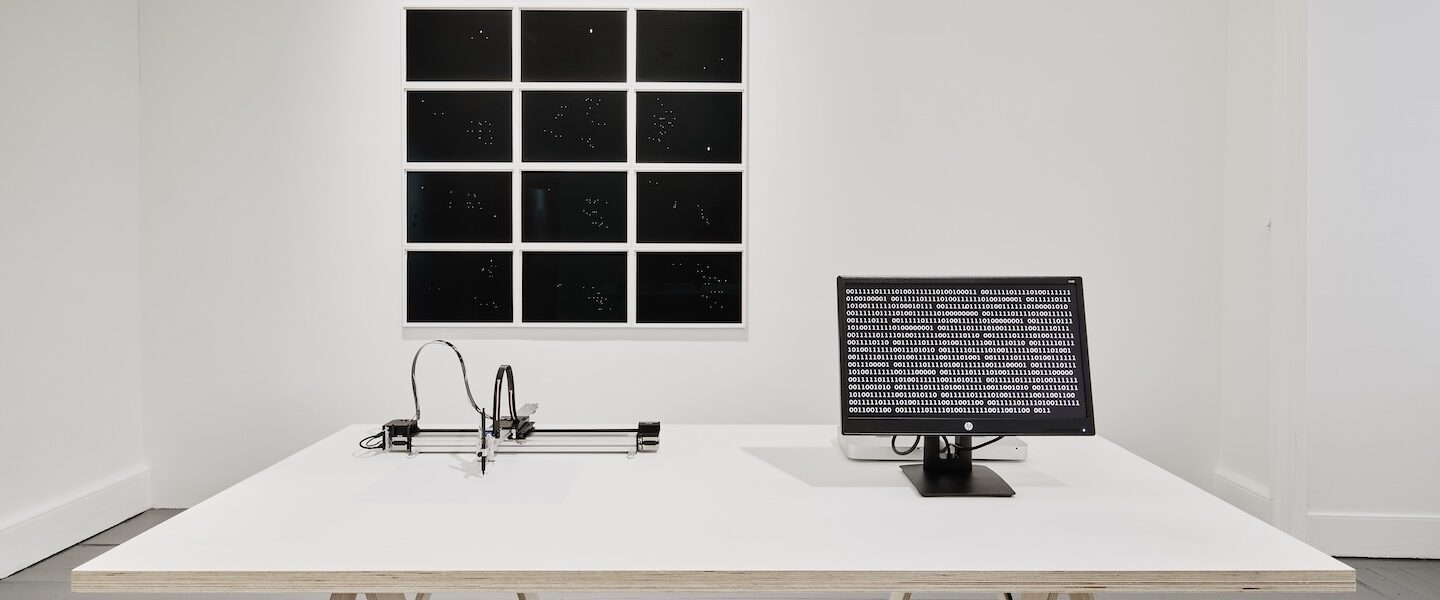
Plotter, computer, monitor, paper, table, 42 x 29.7 paper, installation dimensions variable.In the fourth room of the exhibition, we see the work Morning star/Evening star.
On the table in the centre of the room are a drawing plotter and a computer monitor. The plotter is drawing in real time the transit of the planet Venus through space. After 8 years, Venus returns to the same place in the sky on the same date, creating an intricate circular pattern whose key points contain the markings for a pentagram or a five point star. Articulating its complex movement from the perspective of the Earth, the pattern created is referred to as the Venus Rose. The drawing will be rendered visible by the use of a line plotter, an early graphic device which creates a consistent line and unlike a printer, enables the entire process to be visible as it draws in real time the complex path of the planet as it circumnavigates the heavens.The computer monitor on this table displays the transit of Venus translated to binary code, in synchronisation with the drawing. These two radically different visualisations of the same information reflect the fact that Venus was once thought to be two different stars, appearing in the morning and the evening. The work reflects this idea of the potential of multiple identities or concepts held within one entity.Frege in his essay 'On sense and reference' begins by explaining the cognitive value of identity statements such as the 'The Evening Star is the Morning Star’ with regard to Venus. The distinction between sense and reference was an innovation of Frege in 1892, reflecting the two ways a singular term may have meaning. The identity between the first star we see in the evening and the last star we can see in the morning was an empirical discovery in astronomy, a piece of information that was not available by means of semantic analysing, for it is not contained in the meaning of the term used to describe the heavenly body that appears in the evening and in the morning (not a star but the planet Venus as it turns out). Frege argued, we need to recognise that meaning is a broad semantic category with multiple dimensions, and we need to develop fine-grained distinctions to identify the different semantic ingredients that make up the meaning of a term.The Venus Rose has had broad cultural references over different periods in history. In a typical Renaissance fashion, Heinrich Cornelius Agrippa and others perpetuated the popularity of the pentagram as a magic symbol, attributing the five neoplatonic elements to the five points. However by the mid-19th century a further distinction had developed amongst occultists which depended on the pentagrams orientation. With a single point upwards it depicted the spirit presiding over the four elements of matter, reportedly signifying the five wounds of Christ. Whereas the influential writer Eliphas Levi declares it as a symbol of evil, whenever it appeared the other way, as a reversed pentagram, with two points projecting upwards, because it overturned the proper order of things and demonstrated the triumph of matter over the spirit.Sometimes referred to as the Morning Star, Venus the brightest star in the heavens may be seen as a contradiction to being a symbol of Lucifer, but the role of Lucifer is complex and should not exclusively be depicted as a horned beast. Jan Verwoert in his essay ‘Bring on the Devil’ discusses how the devil was embraced by the Romantics poets such as Baudelaire and Byron whose views in turn were shaped by John Milton’s ‘Paradise Lost’. Milton articulates Satan as the fallen but rebel angel and in doing so constructed him as the idol of the outlawed and as such the devil has become a prime source of identification for many different performers on the social stage of culture, a romantic role model for poets, artists, divas, dandies and disaffected teenagers.
Walker and Walker are leading Irish contemporary artists whose collaborative practice has achieved significant recognition both nationally and internationally. Their work spans multiple forms—film, sculpture, drawing, and installation—and is united by a central focus on the elusiveness of language, exploring how meaning slips and transforms through words, materials, and context.
Their approach is notably research-driven, drawing inspiration from 19th and 20th-century surrealists, poets, and thinkers like Marcel Duchamp, Stephane Mallarmé, and René Daumal. By re-evaluating words and forms in their installations, they liberate words from their standard signifiers, prompting new narratives and interpretations for the viewer. Walker and Walker frequently engage with philosophical concepts; for example, during a recent residency, they developed a film script based on the Situationist notion of “détournement” or creative hijacking, and delved into the writings of utopian theorist Fourier to explore themes of social revolution and domestic oppression.
Their career includes representing Ireland at the 51st International Venice Biennale in 2005, and exhibiting extensively at venues including Madonna Del Pozzo in Italy, IMMA Dublin, the Hugh Lane Gallery, Salzburger Kunstverein Austria, Artspace Seoul, and the Museum of Modern Art, Rio. Landmark works such as the film “Mount Analogue Revisited” have been internationally acclaimed, with their practice recognized for its experimental rigor and depth of cultural reference.
Across three decades, Walker and Walker have established themselves as innovative artists committed to interrogating how language, space, and materiality intersect in contemporary art, always challenging viewers to reconsider the relationships between sign, context, and meaning.