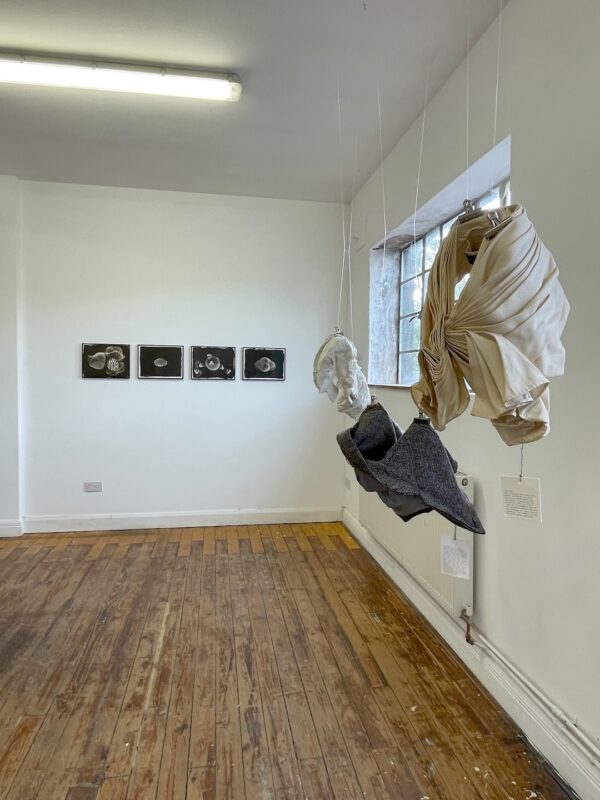
For Culture Night 2026, the studio holders from the Leitrim Sculpture Centre held a weekend exhibition in the Project Space. This was an opportunity for these local artists to work together and show their work to the public.
Tara Baoth Mooney
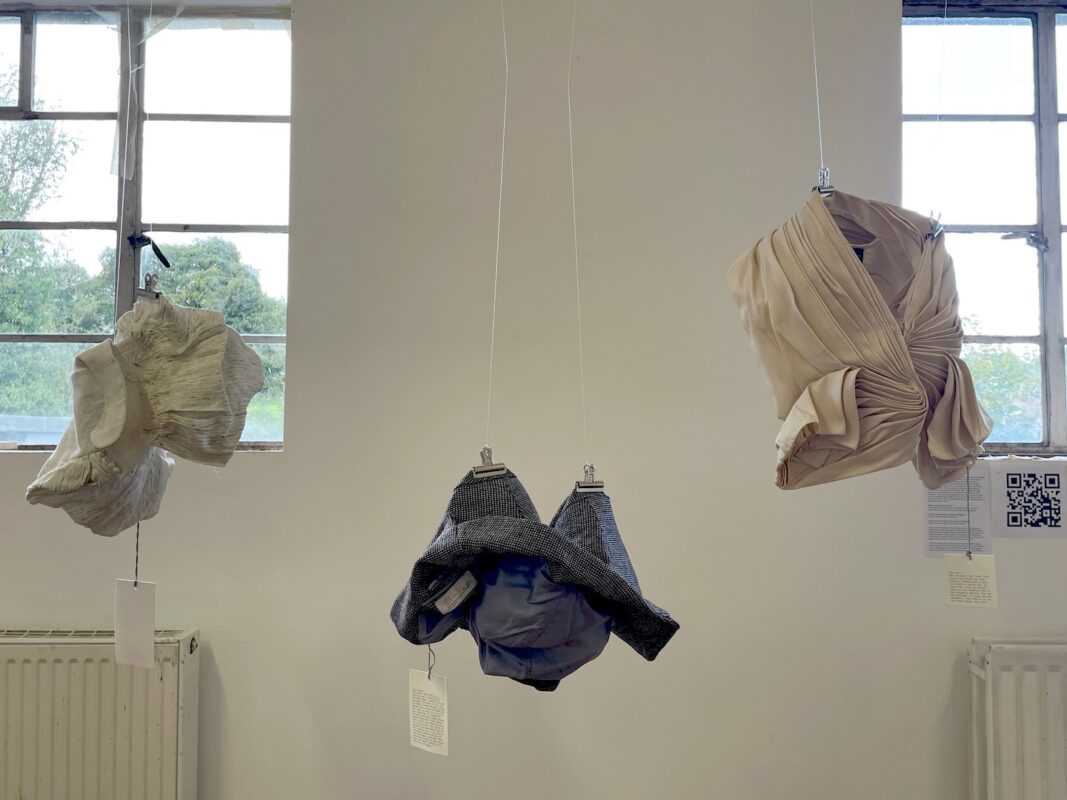
Diary of our daily threads
These pieces are part of a larger body of work that explores how cloth evokes memories of those who once wore or handled it, and how touching and holding old garments and textiles sustains emotional connections. It considers lifeless objects as powerful holders of memory and silent witnesses to lived experience. Four short films, drawn from conversations with people that have become custodians of garments inherited from deceased loved ones, are paired with fabric works. Using hand-sewing, construction and weaving, they each embody a story of loss, love and connection. Each piece is accompanied by a short film of the story which can be accessed through the QR code on the wall. Viewers are invited to become part of the work’s ongoing life through touch, leaving something of themselves within its fibres.
Tara Baoth Mooney is an interdisciplinary artist working across sound composition, performance, textiles, drawing, video and immersive media. Her practice explores memory, identity, ecology and relationships between human and more-than-human worlds, rooted in the landscape of the Burren and North-West. Her work has been presented nationally and internationally across sound, performance, visual art and immersive media. Tara is a member of the experimental sound collective RÚN, (Rocket Recordings, 2025, Áit Collective and a studio holder at Leitrim Sculpture Centre. Tara holds a practice-led PhD in Art-Based Eco-Psychosocial Practice and an MA with Distinction from London College of Fashion.
Crona Gallagher
Cróna Gallaghers printmaking practice is rooted in the natural world, often concerning the mechanics and movement of flight systems of bird and insect life. The work involves deep observation, a focus on and engagement in detail and an ongoing interest in that which is tiny. Themes around myth, legend and the local inform direction and approach. Her work has been exhibited at national and international level and is held in private and public collections.

Cróna Gallagher's printmaking practice is rooted in the natural world, often concerning the mechanics and movement of flight systems of bird and insect life. The work involves deep observation, a focus on and engagement in detail and an ongoing interest in that which is tiny. Themes around myth, legend and the local inform direction and approach. Her work has been exhibited at national and international level and is held in private and public collections.
Mary Theresa Keown
Mary Theresa Keown has been painting for over 30 years. Her work is process-driven, with layering and excavating techniques that allow for continuous change in her compositions. She refers to the works in this show as coffee table paintings, small works that explore different painterly grammars and modernist discourses. This kind of shape-fussing sometimes allows for humor and irony to become the focus of a painting.

Mary Theresa Keown is a native of Belleek, Co. Fermanagh. In 2020 she completed a PhD at the University of Ulster reading feminism and the history of abstract painting. She graduated with first class honours B.A. in Fine Art 1997. She has exhibited her work throughout Ireland, and internationally. Her international shows include Tokyo, Japan, Bilbao, Spain. She has won many awards including the Ireland Fund of Great Britain- artist of the year award in 2001 and her work is housed in many public and private collections.
Anna Macleod
Màiri Nighean Alasdair Ruaidh was a Scottish Gaelic 17th century poet from Harris who lived most of her life as a nursemaid to the Macleod Chiefs on Skye. She was banished from Dunvegan Castle to the Isle of Mull for composing poetry and songs, a traditional preserve of men. Thus she was forbidden to compose poetry ‘either inside or outside’ but continued to do so by sitting in the threshold. Such was her transgression that when she died she was buried face down in Rodel church on Harris, a practice used for witches.
Island communities traditionally harvested sun bleached white mearl debris washed up on the shore for its rich calcium (calcium carbonate), magnesium and essential trace minerals. It was used to improve the pH of acid rich soils, mixed into winter feed for cattle and as a water filter. Additionally there is new archaeological evidence that maerl was used with other harvested biogenic materials such as marine shells as a lime mortar in constrution of stone Brochs in the Iron age and late Norse era.From a series of storytelling embroidered panels made on Skye during Jon Schueler Scholarship at Sabhal Mòr Ostaig. June – September 2026.

Red coralline algae (mearl) from Tràigh an Chlaiginn, Isle of Skye, Indigo dyed Indian muslin, Linen thread, bamboo rods. The pibroch lament is traditionally attributed to Patrick Mòr MacCrimmon. 2026

Anna Macleod is a Scottish / Irish visual artist, researcher and educator based in the North West of Ireland. Her work mediates complex ideas associated with contemporary, historical and cultural understandings of land and water through a variety of visual art media and processes. She has exhibited extensively in Ireland and Internationally since the 1990’s.
Christine Mackey
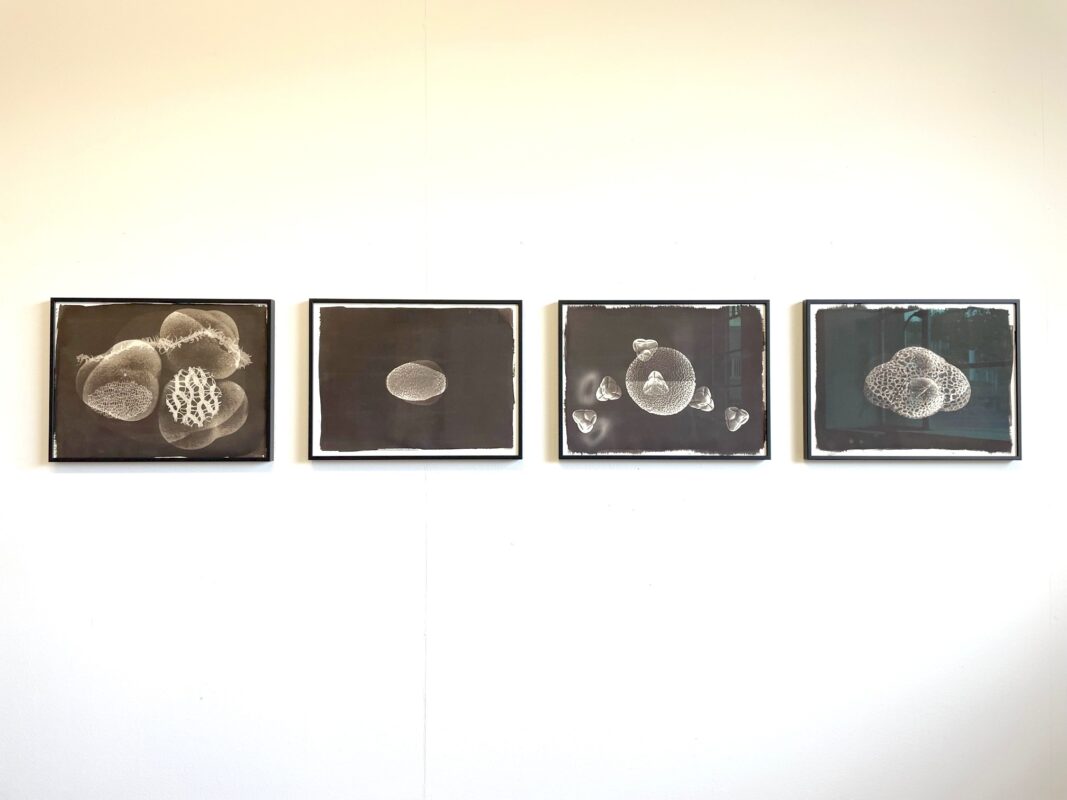
Stellula, Bencroy, Living archive, 2026 - ongoing
Produced as part of the WaterLANDS residency 2023-2026 (Ireland)
Stellula (meaning little star or stellate) refers to the star-shaped structure of the capitulum in certain Sphagnum moss species. Moving between scales this ongoing series of analogue prints reveal the morphology of micro-sopic pollen samples collected on-site. These samples are magnified, digitally hand-drawn and layered to produce unique negatives that are then printed using an a 1800 print-out process Van-dyke.
Christine Mackey is an independent research-based visual artist attending to complex environmental issues, iterated through a range of site-specific and socially engaged contexts, mediated and assembled through a range of material and digital processes. In 2025, she presented a major solo exhibition at The Model, Sligo, supported by an Arts Council Projects Award. Current and recent residencies include The Garden Studio at Butler Gallery, FarmWalks, The Dock, and WATERlands Horizon (UCD). International residencies include CRUX, Newfoundland (Canada), CCI (Paris), Jeollanam-do Cultural Foundation (South Korea), and Woodland Symposium / Interface (Galway). Alumni Fulbright Research Scholar (2018) and graduate of the University of Ulster with a practice-based PhD (2012). Mackey’s work is supported by The Arts Council of Ireland bursary and projects awards, Leitrim Arts office and Culture Ireland.
Some moments from the show